



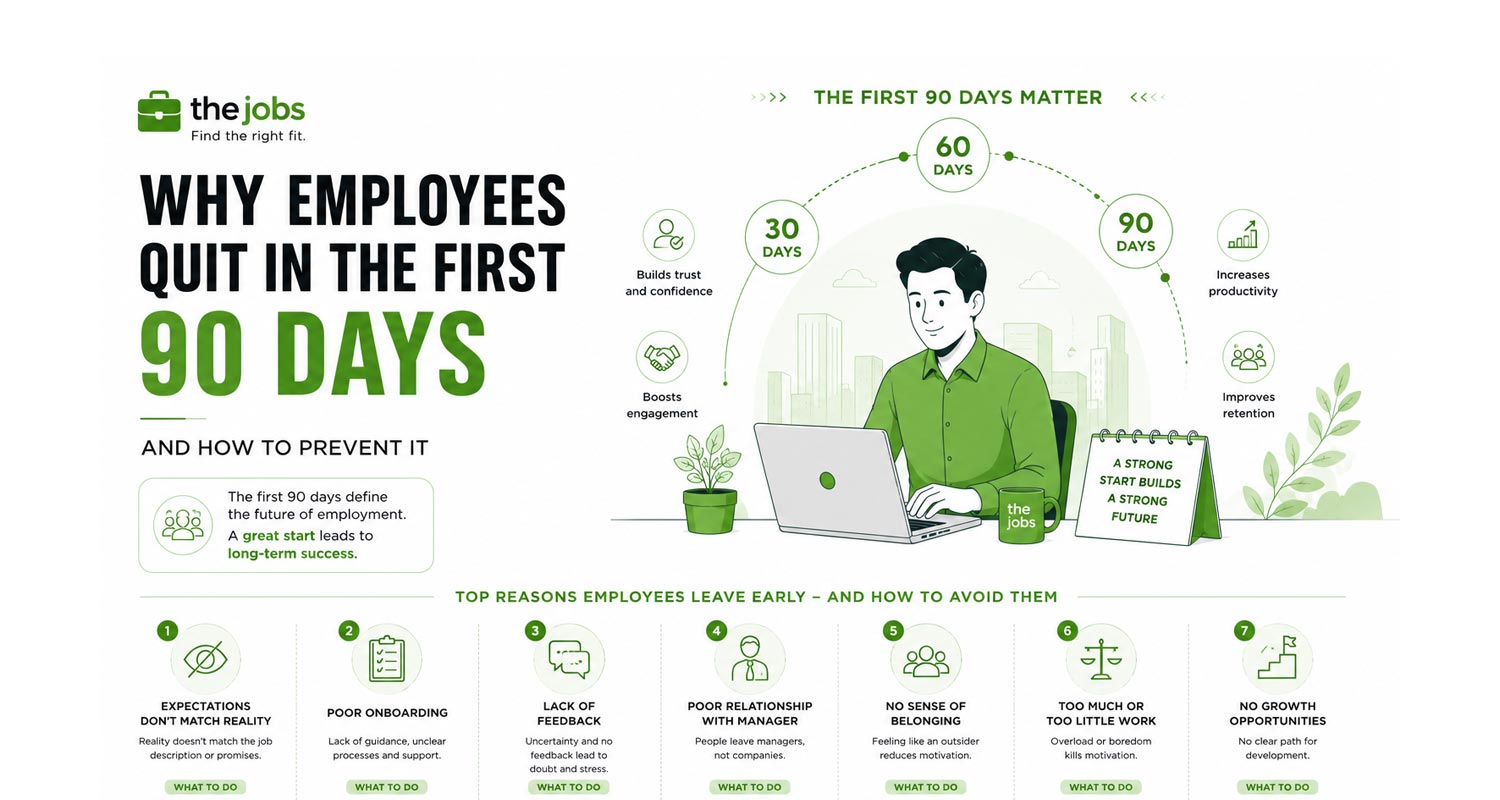
Why Employees Leave Within the First 90 Days — And How to Prevent It
The first three months of employment are among the most critical stages in a new employee's journey. During this period, employees form their first impressions of the company, its culture, their manager, colleagues, and day-to-day responsibilities. If reality does not match expectations, the likelihood of early resignation increases significantly.
According to numerous labor market studies, a substantial percentage of voluntary resignations occur within the first 90 days of employment. For employers, this means wasted time, increased recruitment costs, lost productivity, and the need to restart the hiring process.
Why do new employees leave so quickly? What mistakes do companies make, and what can employers do to improve employee retention? Let's examine the most common reasons and practical strategies to address them.
Why the First 90 Days Matter
The first months on the job are an adaptation period. New employees become familiar with the company's culture, internal processes, colleagues, and management expectations.
When onboarding is successful, employees become productive faster and begin to feel like valuable members of the team. When challenges arise and support is lacking, engagement decreases, motivation fades, and employees begin considering other opportunities.
For this reason, the first 90 days often determine whether an employee builds a long-term career within the company or starts looking for another job.
Reason #1. Reality Doesn't Match Expectations
One of the most common reasons for early resignation is the gap between the job description and the actual role.
Sometimes a position appears attractive during the recruitment process, but once employees begin working, they discover different responsibilities, working conditions, or levels of responsibility than they expected.
This mismatch creates disappointment and damages trust in the employer.
How to Prevent It
- Write accurate and transparent job descriptions.
- Clearly explain responsibilities during the interview process.
- Avoid making promises the company cannot keep.
- Introduce candidates to their future manager before their first working day.
Reason #2. Poor Onboarding
Many organizations believe onboarding is complete once they provide a laptop, complete paperwork, and show employees where they will work.
In reality, successful onboarding requires much more.
When new employees don't understand their responsibilities, internal processes, or company expectations, they often experience stress, uncertainty, and frustration.
Best Practices
- Develop a structured 30-, 60-, and 90-day onboarding plan.
- Prepare a comprehensive onboarding checklist.
- Assign a mentor or buddy.
- Schedule regular meetings with the direct manager.
Reason #3. Lack of Feedback
New employees constantly ask themselves questions such as:
- Am I doing my job correctly?
- Am I meeting expectations?
- Is my manager satisfied with my performance?
Without regular feedback, uncertainty grows and confidence declines.
The Solution
Hold short one-on-one meetings every week during the probation period.
Discuss:
- achievements;
- current challenges;
- expectations;
- development goals.
Regular feedback helps employees adapt faster, improve their performance, and feel supported.
Reason #4. Poor Relationship with the Manager
There's a well-known saying:
"People don't leave companies—they leave managers."
In many cases, management style is the primary reason employees resign.
If a manager:
- is unavailable;
- constantly criticizes;
- provides little guidance;
- shows little respect;
new employees are unlikely to stay for long.
What Employers Can Do
Train managers in leadership, communication, coaching, and mentoring skills. This is especially important for leaders who regularly onboard new team members.
Reason #5. Lack of Belonging
Even highly skilled professionals may leave if they feel isolated within the organization.
New employees need to feel that they are part of the team.
This can be achieved through:
- introductions to colleagues;
- team meetings;
- collaborative projects;
- company events;
- an open and inclusive workplace culture.
Reason #6. Too Much—or Too Little—Work
Some organizations overwhelm new employees with responsibilities from the very first day.
Others make the opposite mistake by giving them almost nothing meaningful to do.
Both situations reduce motivation and slow adaptation.
The best approach is to gradually increase responsibilities as employees gain confidence and experience.
Reason #7. No Growth Opportunities
Today's professionals want to understand their future within the organization.
During their first months, they naturally ask questions such as:
- What career opportunities are available?
- Can I grow here?
- What new skills will I develop?
If employers cannot provide clear answers, motivation often declines.
How to Reduce Employee Turnover During the First 90 Days
A well-designed onboarding experience significantly increases the likelihood that new employees will stay.
Best practices include:
- preparing the workspace before the employee's first day;
- sending a welcome message before they join;
- assigning a mentor or onboarding buddy;
- creating a structured 90-day onboarding plan;
- scheduling regular one-on-one meetings;
- collecting employee feedback;
- introducing company culture and values;
- recognizing early achievements.
The Cost of Early Employee Turnover
Many employers underestimate the true cost of losing new employees.
Early turnover results in:
- repeating the recruitment process;
- additional job advertising expenses;
- increased HR workload;
- conducting new interviews;
- reduced team productivity;
- additional pressure on existing employees.
In many cases, replacing an employee costs significantly more than investing in a high-quality onboarding program.
Conclusion
Employee retention begins long before the probation period ends—it starts with the very first interaction between a candidate and the company.
Transparent communication, structured onboarding, continuous feedback, and supportive leadership help new employees adapt more quickly, feel like valued members of the team, and reach their full potential.
Organizations that invest in their employees' first 90 days achieve higher engagement, lower turnover, and a stronger workplace culture. In today's competitive labor market, effective onboarding is no longer just an advantage—it has become an essential component of a successful HR strategy.